
Y-Strainer - ANSI
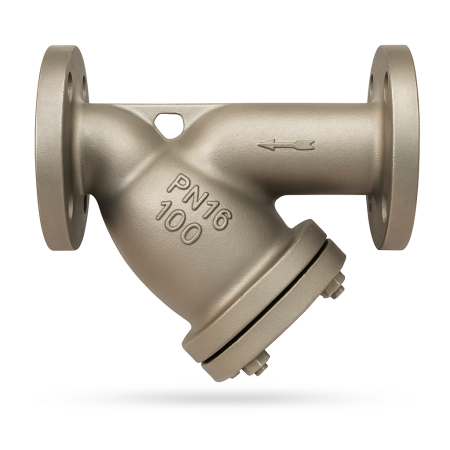
Pipelines carrying fluids and gases can be exposed to contamination. A strainer acts as a filter, preventing foreign particles from entering the system and protecting valves and pipes from fouling. The mesh size is chosen according to the size of the particles to be filtered.
The Key features of strainer valves
Strainers function as reliable filters in pipelines, safeguarding valves from contamination. The mesh size is tailored to the particle size. Strainers are easy to clean or replace, typically made of stainless steel, and for larger nominal sizes, can be equipped with a heavy-duty lifting hook.
Effective contamination protection
Strainers remove solids from fluids and gases, keeping pipelines and valves clean and ensuring smooth operation of the plant.
Easy maintenance
The filter element (screen) can be quickly accessed for cleaning or replacement by removing the cover. Replacement filters can be ordered directly, and a gasket change is recommended after pressure release.
Robust design and adaptable features
The filter element is normally made of stainless steel, but other materials are available. For larger valves, a heavy-duty lifting hook can be added for easier handling during installation.
Y-Type Strainer Dirt Catcher
Datasheets
Size: 1/2” to 8” (larger nominal sizes also available)
LBS: 150, 300, 600
Body materials: 1.0619, A216 WCB, 1.4408, 1.4306, 1.4404, 1.1138, 1.4308, 1.5419, 1.7357, 1.7379, CF8M, CF3M, CF3, WC1, WC6, WC9, LCB, LCC
Description of our Strainer Valves:
These strainers are built to meet ASME B16.5 face-to-face dimensions and are ideal for capturing debris in pipelines. The filter screen can be conveniently removed from above for maintenance or replacement. Customers can choose from a range of mesh sizes to match their specific needs. All valves include a declaration of conformity and are available with flanged connections (ASME B16.5) or butt-weld ends (BW) according to ASME B16.25.
- Disassembly and cleaning of the valve
- Inspection for wear and damage
- Procurement of spare parts
- Machining of sealing surfaces (seat/plug)
- Replacement of all seals
- Pressure and leakage testing
- Renewal of corrosion protection
- Painting work